
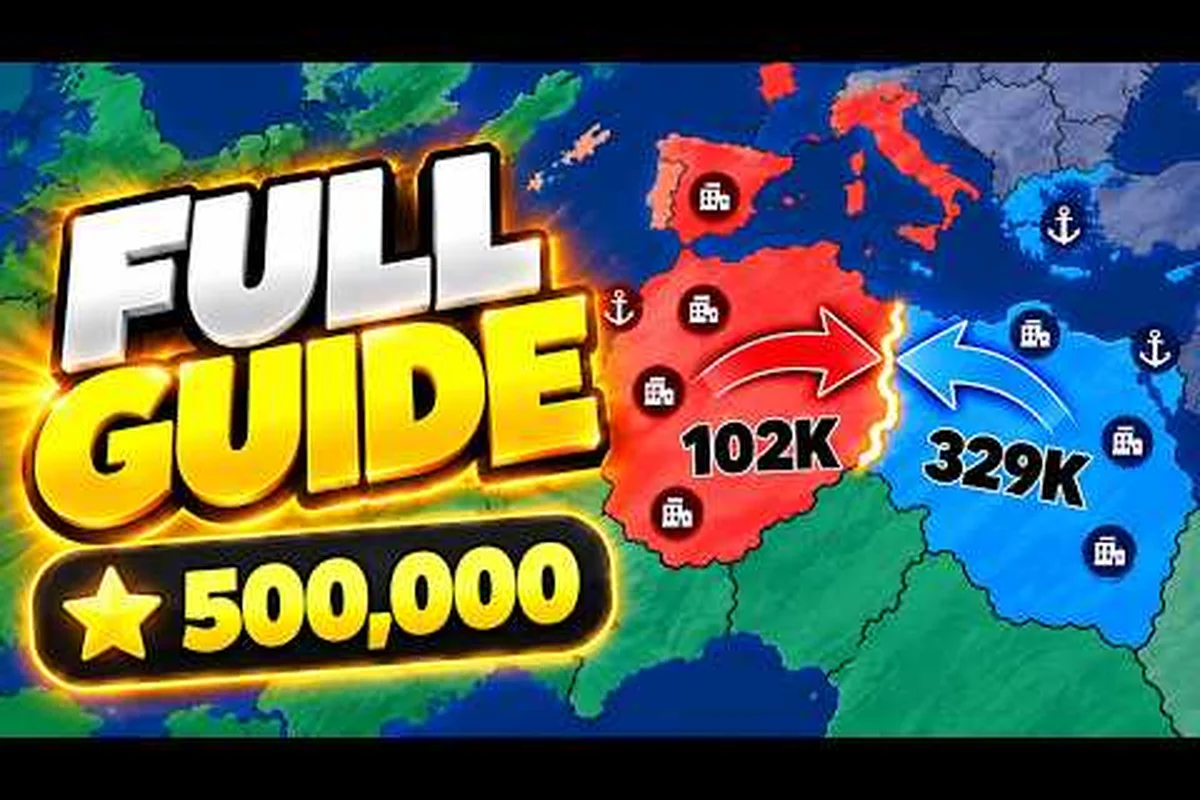
The rofront roblox game turns a shared world into a real-time strategy contest where nations compete for land, resources, and military power. Understanding its central systems and development history reveals why the world pvp format matters for both new players and experienced conquest planners.
RoFront Roblox Game Overview and Core Features
The rofront roblox game combines territorial control, economic development, diplomacy, and large-scale warfare on one persistent-looking world map. According to the official RoFront page on Roblox, the server can contain 55 players, while the world is divided among 88 player nations and numerous tribes. That format makes each match feel connected even though the map remains crowded.
The official listing describes a victory condition involving control of 80% of the world, giving players a measurable target rather than an open-ended sandbox objective. As of the verified October 25, 2026 page snapshot, RoFront had passed 43.6 million total visits, attracted more than 52,900 favorites, and showed roughly 20,800 players online. Those figures illustrate the scale of interest, although live activity naturally changes throughout the day.
| RoFront game info | Verified figure or feature | Practical significance |
|---|---|---|
| Total visits | 43.6M+ | The game has reached a substantial audience |
| Favorites | 52.9K+ | Many players have marked the experience for later |
| Reported online players | About 20.8K | Active participation is visible beyond a niche launch |
| Server capacity | 55 players | Nations and tribes share a crowded battlefield |
| Political entities | 88 player nations | Expansion occurs within a divided world |
| Stated victory goal | Control of 80% of the world | Progress can be measured against a clear target |
The rofront world pvp meaning is straightforward: players act as political and military leaders, directing development and conflict across the same map. Unlike an isolated arena match, every construction, alliance, and offensive operation can influence how other territories operate. The result is a strategy game where logistics matter as much as troop strength.
What players actually control
Players begin by developing a nation rather than simply choosing a character for a conventional team deathmatch. In RoFront, the player’s main role shapes a national faction across production, territorial control, and military operations, so a decision about one front can alter the viability of another. For example, improving a city’s infrastructure can increase the resources available to recruit troops, while securing a port may shorten supply routes and make later territorial expansion easier to sustain.
-
Territorial expansion: New regions provide more land, resources, and strategic positions, but they can also expose borders to attack.
-
Economic development: Cities, ports, and factories support the larger war effort, so construction choices influence how quickly a nation can mobilize.
-
Military organization: Troops need training and direction, while alliances can reduce pressure from several enemies at once.
-
Diplomatic choices: Forming partnerships or coordinating attacks may create opportunities that would be dangerous to attempt alone.
-
Large-scale weapons: The official page mentions nukes as part of the late-game arsenal, but their value depends on positioning, timing, and the state of a nation’s economy.
This combination explains the appeal of the rofront world pvp game format. A player can influence the same contest through construction, cooperation, or warfare, and no single approach works in every situation. The broader history of the project also clarifies how this Roblox adaptation reached its present design.
RoFront World PvP Mechanics and Strategy
World pvp works through connected systems rather than isolated minigames. A nation that captures ground gains potential resources, but expansion also creates additional borders to defend. That trade-off remains central to the rofront roblox game and makes every offensive decision relevant to the broader match.
Territory, economy, and military readiness
Territory is the foundation of the system, yet possession alone does not create an advantage. Resources must be converted into useful infrastructure and units. A newly captured region may be geographically valuable, while a developed city can provide the production needed to sustain repeated campaigns. The strongest players therefore evaluate both land value and operational cost.
| Strategic layer | Main decision | Common mistake | Better approach |
|---|---|---|---|
| Territory | Where to expand next | Capturing weak land far from supply routes | Favor useful positions that can be supported |
| Economy | What to build and when | Spending everything on visible military power | Balance production, infrastructure, and defense |
| Troops | Where to deploy them | Sending every unit into one attack | Keep reserves for counterattacks and emergencies |
| Alliances | When to trust partners | Relying on promises without clear coordination | Agree on targets and timing in advance |
| Heavy weapons | When to strike | Using them before the map is prepared | Save them for decisive, well-supported moments |
The r/Roonby community discussion also describes territory control, economic growth, troop training, and fighting neighboring nations as the core competitive loop. Because that player advice can lag balance updates, it is best treated as strategic context rather than a permanent rules reference. The official page remains the strongest source for the current broad structure.
Reading the map
Map awareness determines whether an attack is practical. A close target may look easy to capture, but its distance, terrain, nearby allies, and supply situation can make it costly. Conversely, distant targets can offer excellent value when a player controls intermediate land or has secured a dependable staging area.
A useful scouting routine includes four separate checks. First, identify which borders are unstable. Second, determine whether enemy cities are producing units continuously or only preparing a limited attack. Third, watch for movement that suggests alliance coordination. Fourth, compare the value of the target with the cost of holding it after the capture.
The RoFront world map guide can help readers organize this information around the actual geography. Understanding where resources, settlements, and enemy territory sit makes planning more concrete, especially when the shared map contains dozens of nations and smaller tribes competing for the same routes.
Managing a multi-front campaign
A nation may face pressure from several directions, so defense cannot depend on one wall of units. Players need to identify which threat is most urgent, which front can use natural barriers, and where an allied force might intervene. Dividing troops across too many locations is a common weakness because each force can become weaker than the attacking side.
A better campaign usually follows a simple sequence: stabilize the economy, secure a defensible interior, identify the most rewarding neighboring target, coordinate the attack, and preserve a reserve. This sequence does not guarantee victory, but it prevents scattered decisions that consume resources faster than the nation can recover them.
RoFront Game History and Development Background
The rofront game history is closely connected to the broader Open Front tradition of territory-based strategy. The official listing credits Open Front for the map concept, while RoFront adapts that style into a Roblox multiplayer experience with its own setting, interface, progression, and community. To understand the distinction more clearly, compare the background of RoFront and Open Front.
From Open Front inspiration to Roblox adaptation
Open Front established a recognizable model in which countries expand across a shared world map, develop infrastructure, and fight for control. RoFront carries that central premise into Roblox, where the history of the original concept helps explain the territory-driven structure many players recognize from browser strategy titles.
| Aspect | Open Front influence | RoFront presentation |
|---|---|---|
| Core conflict | Expand a nation and compete for territory | Roblox-based shared-world conquest |
| World structure | A map divided among political actors | 88 player nations plus tribes |
| Progress | Economy and military development | Cities, ports, factories, troops, alliances |
| Victory emphasis | Control of the map | Official goal of controlling 80% of the world |
| Multiplayer setting | Browser strategy ecosystem | Roblox servers with up to 55 players |
That does not mean the two experiences are identical. Platform access, visual style, onboarding, community behavior, and the pace of development are separate concerns. A player can understand the broad inspiration while still finding differences in the Roblox adaptation. The official listing also identifies the development team as Torrey Pines, which is useful for separating creator information from the source material that inspired the design.
Who developed RoFront
The official creator listing points to the Torrey Pines Roblox development group, which had roughly 7,782 members at the October 25, 2026 snapshot. The official developer overview examines the group’s role and the distinction between the Roblox studio and the earlier game concept that inspired the project.
The rofront development history is still short because the official Roblox page was created on September 26, 2026. Yet its rapid rise to more than 43.6 million visits suggests that the game found an audience quickly. Roblox pages can show large lifetime visit counts even for recent releases, because the platform already has a large audience and strong recommendation systems, so the figure should not be treated as the number of unique players.
| History milestone | Date or snapshot | What it indicates |
|---|---|---|
| Roblox page created | September 26, 2026 | Start of the public RoFront listing |
| Development attribution | Torrey Pines | Studio responsible for the Roblox release |
| Total visits | 43.6M+ by October 25, 2026 | Very fast growth in platform exposure |
| Favorites | 52.9K+ by October 25, 2026 | Strong early interest and follow-up intent |
| Development group members | About 7,782 | Size of the listed Roblox community group |
These figures are a dated snapshot rather than a permanent record of RoFront’s performance. For example, the 43.6M+ visits, 52.9K+ favorites, and roughly 7,782 Torrey Pines group members were recorded for October 25, 2026, while the official Roblox page only opened on September 26, 2026. Because visits, favorites, favorites-to-visit ratio, and concurrent player counts can change between refreshes, readers should check the official RoFront page and Torrey Pines group listing before using those metrics to compare RoFront with other Roblox experiences.
RoFront Features, Player Roles, and Early Decisions
The most useful rofront game info begins with player choice. Although every participant operates within a nation, different decisions create distinct paths to influence. A player may focus on construction, diplomacy, intelligence, or direct military pressure. The best role often depends on the nation’s current needs rather than on a fixed class.
Builder, diplomat, scout, or commander
Players who enjoy planning can concentrate on cities, ports, factories, and resource routing. Their influence may appear through a stronger economy rather than a dramatic battle. Diplomats coordinate alliances and identify shared threats. Scouts watch borders, gather information, and warn leaders about movement. Commanders organize attacks, protect key territory, and exploit temporary weaknesses.
| Player contribution | Early focus | Best time to act | Measurable result |
|---|---|---|---|
| Builder | Economy and infrastructure | Before major pressure arrives | Higher production and recovery capacity |
| Diplomat | Alliances and coordination | When several nations face common threats | Fewer simultaneous enemies |
| Scout | Border activity and enemy plans | Before committing troops | Better target selection |
| Commander | Troop deployment and defense | When timing and terrain align | Fewer lost territories |
The strategy guide for gaining world control offers deeper recommendations for early, middle, and late stages. What matters for this overview is that the roles complement one another. A commander with a weak economy may conquer quickly and then lose momentum, while a builder without military support may develop resources that never become territorial gains.
Choosing a starting location
A useful opening position offers room to build, access to a neighbor, and enough defensible space to survive the first exchanges. Players should avoid choosing solely by visual appeal or the promise of easy resources. A quiet border can be useful, but a nation that cannot connect its cities to combat zones may struggle to convert production into power.
During the opening phase, players should observe neighboring development before fixing a long-term path. Some territories appear quiet because they are being developed carefully; others look active because their owners want attention elsewhere. Early information gathering helps distinguish preparation from genuine weakness.
Learning through observation
Because RoFront is competitive, every battle contains useful lessons. Watch how rivals build, when they attack, which territories they ignore, and whether they protect cities or remote expansion. Community reports suggest that experienced players also pay close attention to coordination and resource management, although current mechanics may change faster than older player advice.
A short after-action log can improve consistency. Record three items after each major engagement: the goal, the cost, and the result. Over time, patterns become visible, such as repeated attacks on a specific border or an economy that grows faster after certain infrastructure choices.
RoFront Strategy Guide for New and Experienced Players
Success in the rofront world pvp game depends on choosing priorities instead of reacting to every visible action. A practical plan separates the economy, army, territory, and diplomacy into manageable layers. That structure works for beginners because it reduces confusion and also helps experienced players recognize when a routine needs to change.
A repeatable opening plan
In the rofront roblox game, the opening phase works best as a risk-control exercise rather than a race for the nearest city. Establishing a core with secure resource production gives the player time to scout neighboring nations and classify their troop activity, border position, and likely alliances. For example, a player facing a heavily militarized neighbor should prioritize defensive infrastructure and a mobile reserve before committing to an expansion target, since an early capture without stable production can expose the base to a second front.
-
Survey nearby nations: Record their cities, military activity, border position, and apparent alliances.
-
Develop essential production: Build enough infrastructure to support normal troop production without draining every resource.
-
Select one expansion target: Favor a neighbor whose value justifies the travel, capture, and defense cost.
-
Create a buffer zone: Capture useful intermediate land before attempting a distant opponent.
-
Keep a mobile reserve: Hold enough military capacity to respond to an unexpected second front.
-
Review the economy weekly: Adjust construction when spending has created a production shortage.
-
Coordinate before large attacks: Confirm timing, target selection, and retreat conditions with allies.
-
Consolidate after victory: Repair and protect captured territory instead of immediately chasing another target.
| Game phase | Primary objective | Common distraction | Recommended focus |
|---|---|---|---|
| Opening | Establish production and scout | Attacking the nearest enemy | Secure development and gather information |
| Expansion | Gain useful neighboring land | Capturing scattered weak regions | Build connected territory |
| Midgame | Strengthen alliances and borders | Overextending the army | Improve logistics and reserve capacity |
| Late game | Contest decisive map control | Rushing with an unstable economy | Synchronize attacks and protect key areas |
When to expand, defend, or negotiate
Expansion is attractive when the target offers resources, infrastructure, or a favorable position. It is risky when the player lacks production, reinforcements, or a safe line of retreat. Defense is preferable when an opponent is probing weak borders or when the interior economy needs protection. Negotiation becomes valuable when multiple opponents target the same region, although allies still need clear expectations.
A useful decision rule is to compare three values: the strategic benefit of the target, the immediate military cost, and the long-term maintenance cost. The first captures, such as resource access or a safer border, are often worth more than a distant area that requires constant guarding.
Heavy weapons should follow the same discipline. A nuke or comparable late-game option can reshape a region, but using it before victory conditions are close may create an opening for another nation. Strong timing involves concentrated targets, allied distraction, and a defensive plan for the response.
Learning from community experience
According to community discussion, players repeatedly emphasize economy, troop training, territorial pressure, and coordinated action. These recommendations align with the official mechanics, but community data can lag patches and balance changes. Treat player reports as practical experiences, not permanent rules, and confirm uncertain details against current in-game information.
That caution is particularly important during a fast-growing release. The project’s recent history, active audience, and ongoing development suggest that interface guidance and balance may change. Good strategy should therefore rely on principles that remain stable: secure production, preserve optionality, coordinate before major commitments, and avoid treating one visible weakness as the entire enemy plan.
RoFront Roblox Game Information and Final Assessment
RoFront delivers a recognizable grand-strategy experience through Roblox, but its identity comes from the shared world and constant interaction among nations. The official rofront roblox game page records a young release with striking early growth, while the development group and Open Front attribution provide essential context for rofront game history. The result is easy to summarize yet difficult to master.
| Question | Best-supported answer |
|---|---|
| What genre does RoFront represent? | A shared-map conquest strategy game with economy, diplomacy, and real-time warfare |
| How many players can a server hold? | Up to 55 players according to the official Roblox listing |
| How many nations are represented? | The official description lists 88 player nations and additional tribes |
| What is the stated victory goal? | Control 80% of the world |
| Who developed the Roblox version? | Torrey Pines |
| What inspired the map concept? | Open Front, according to the official listing |
| Is it based on a single battle type? | No, expansion, construction, alliances, intelligence, and warfare interact continuously |
For new players, the best approach is to learn the economic and territorial systems before committing to large attacks. Experienced competitors can refine that foundation with timing, intelligence, and alliance management. This overview ultimately shows why RoFront is more than a Roblox war game: it combines platform accessibility with the depth of a world conquest contest, while its youthful development history leaves plenty of room for the experience to keep evolving.
Frequently Asked Questions
What is the rofront roblox game?
RoFront is a Roblox strategy game built around conquest of a shared world map. Players control nations, develop cities, ports, and factories, train troops, form alliances, and fight for territory. The official listing says a server can hold 55 players and presents control of 80% of the world as the victory goal.
What does rofront world pvp mean?
It means that player-run nations compete simultaneously on the same map, rather than playing in isolated matches. Territory connects directly to economic and military decisions, so a border attack, new city, or alliance can affect the wider server. Ownership may also shift quickly when several powers contest the same region.
Who developed the rofront roblox game?
The official Roblox listing attributes development to Torrey Pines, the Roblox group also credited as the creator. The team adapted the Open Front map concept into a Roblox experience, adding its own presentation and multiplayer structure. More details about the studio and its role appear in the RoFront developer overview.
When was the RoFront Roblox page created?
The official RoFront Roblox page was created on September 26, 2026. The page grew quickly afterward, recording more than 43.6 million total visits by the verified October 25, 2026 snapshot. Roblox visit totals are not the same as unique-player counts, so the figure reflects platform activity rather than the exact player population.
Is RoFront based on Open Front?
Yes, according to the official Roblox description, which credits Open Front for the map. The two experiences share the broad territory-conquest concept, although RoFront presents that concept through Roblox with its own interface, community, progression, and multiplayer format. The Open Front and RoFront background guide compares the relationship in greater detail.