
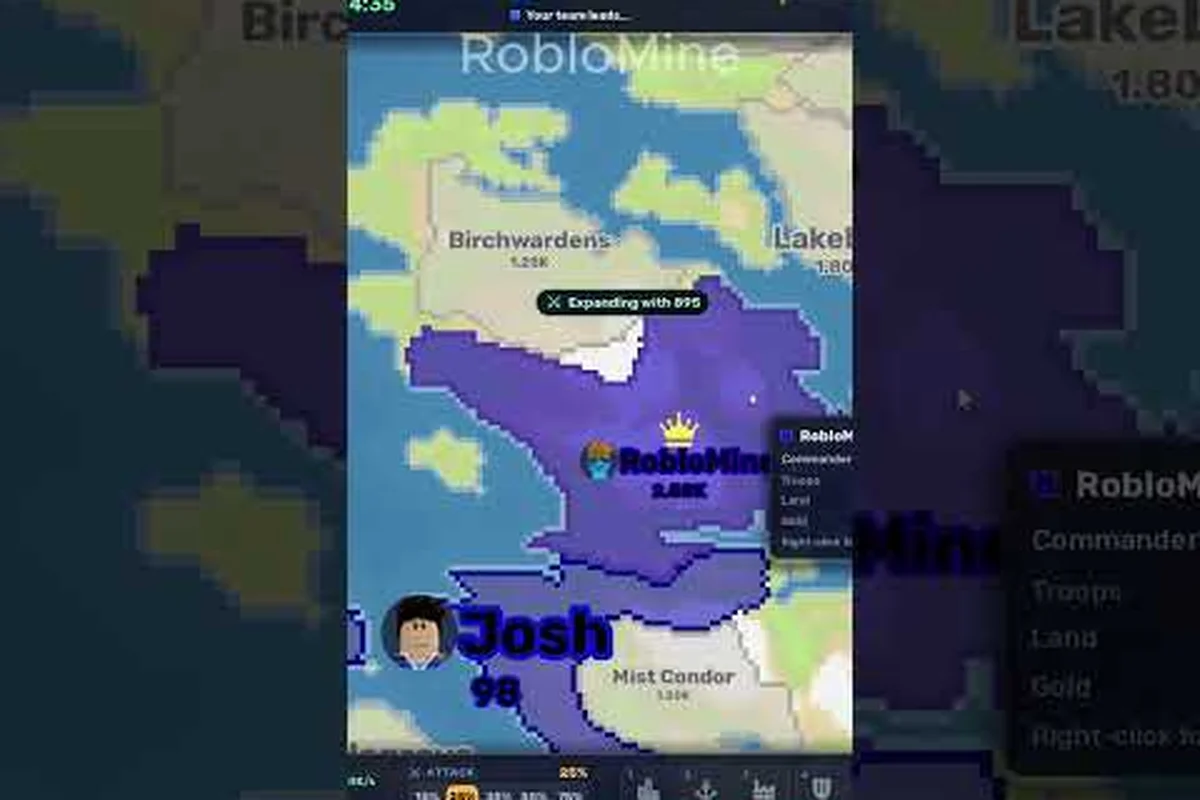
RoFront is a Roblox World PvP strategy title that asks what is rofront in practice: a shared-world conquest game where players expand nations, build cities, ports, and factories, negotiate alliances, and race toward 80% world control. This article covers the rofront what is rofront question from four angles—genre placement, core gameplay loop, history, and whether the game fits different player types—so newcomers can judge quickly whether the pace, diplomacy, and territory pressure suit their preferences before investing time in its developing meta.
RoFront Overview: A Roblox World PvP Strategy Game
RoFront is a Roblox strategy game centered on real-time territorial conquest across one shared world map. In short, rofront what is rofront describes a multiplayer experience where players expand a nation, develop cities and infrastructure, train forces, negotiate alliances, and attack rivals. That matters because understanding this format helps players distinguish it from ordinary Roblox action games and approach its economy, diplomacy, and combat with the right priorities.
The official RoFront game page identifies it as a World PvP title and states that the objective is to control 80% of the world. Its combination of territory, infrastructure, diplomacy, and large-scale conflict is the central answer to the question players often ask when they first encounter the game.
| RoFront feature | What it means for players |
|---|---|
| Shared world map | Every participant operates within the same strategic environment |
| Nation expansion | New territory increases a player's strategic footprint |
| Cities, ports, and factories | Development supports economic and military growth |
| Alliances | Cooperation can create a buffer against stronger rivals |
| 80% control objective | The match rewards broad territorial dominance |
| Nuclear weapons | High-impact options can alter conflicts, but require resources |
What makes RoFront different
The defining feature of this open front Roblox experience is the combination of persistent-looking world competition and practical resource management. A player is not simply collecting weapons or completing isolated missions. Instead, territorial access shapes the economy, while the economy supports troops and infrastructure, and military strength determines which neighboring regions can be occupied.
This creates a feedback loop: territory supports development, development strengthens armies, and armies can capture more territory. The best approach depends on current threats, available resources, and whether the player wants to expand peacefully, maintain a large alliance, or concentrate on a decisive offensive.
RoFront Gameplay: Economy, Territory, and Real-Time Combat
RoFront is rofront good as a Roblox experience? The strongest answer depends on what kind of game a player enjoys. It is particularly suitable for those who want persistent strategy, territorial decisions, economic progression, and competition against many other players. It may feel less immediately accessible than a conventional action game, because a successful session requires planning and an understanding of how development supports expansion.
The strategic game loop
The core loop begins with a nation and expands through repeated decisions. Players establish or improve settlements, generate resources, strengthen their military, and select targets. Those targets may be distant rivals, vulnerable neighboring states, or strategically important territory that connects otherwise separated regions.
| Stage | Main objective | Useful approach |
|---|---|---|
| Early development | Stabilize the starting nation | Balance construction, economy, and basic defense |
| Regional expansion | Secure nearby territory | Prioritize defensible borders and useful coastal access |
| Military buildup | Prepare for larger conflicts | Compare unit strength with local threats |
| Alliance building | Reduce pressure from strong players | Share targets and avoid being isolated |
| Final domination | Reach the 80% control goal | Coordinate attacks while protecting vulnerable regions |
A useful detail comes from community discussion, where players describe territory control, economic development, troop training, and direct conflict as central parts of a successful strategy. Community reports also suggest that beginners benefit from avoiding repeated large-scale battles before their economy and army can support them. Because balance can change, these observations should be treated as current player experience rather than a guarantee of fixed meta priorities.
Territory matters because it changes your options
Controlling land offers more than a larger colored area on the map. It can provide room to build, access to resource-producing locations, and stronger strategic depth. A nation with a well-placed port may also benefit from a more functional economy than one that expands only in a convenient direction.
Expansion still needs a plan. Moving in one direction may create a long border that becomes difficult to defend, while rapid growth can stretch construction and military production too thin. Territorial integrity is therefore more valuable than a large but fragmented empire. Players should examine border shape, nearby rivals, and resource access before committing to a conquest.
Combat and diplomacy serve different purposes
RoFront combines military action with negotiation, and treating one as optional can create major strategic weaknesses. A strong army may deter attacks, but alliances can redirect a rival's attention and reduce the cost of defending multiple fronts. Conversely, an alliance cannot replace basic defenses if partners have different priorities.
The distinction between cooperation and dependency matters. Useful alliances support shared objectives, but every player should retain enough economic and military capacity to respond when circumstances change. This is especially important in a shared-world match where borders, resources, and opponents can change while an alliance is still forming.
RoFront History and Its OpenFront Roots
RoFront is a relatively new Roblox project: the official game page shows a creation date of September 26, 2026 and a last update on October 24, 2026. That short development window explains why its early history should be described as a rapid launch followed by frequent iteration rather than a long-established release history.
The project's clearest historical link is OpenFront. The official Roblox description credits the Open Front game and map, while the OpenFront on Steam describes a multiplayer real-time strategy game in which hundreds of players compete on one shared world map. RoFront adapts that broad conquest concept for Roblox.
A Roblox interpretation of shared-world conquest
The open front game concept relies on a large common map, many participants, persistent territorial stakes, and direct competition between economies. OpenFront presents that formula as a dedicated desktop strategy title. RoFront translates the same broad design into a Roblox experience, making the central strategy available through familiar Roblox controls and social systems.
That is why an openfront comparison is useful, but it needs nuance. The shared-world foundation, territorial objective, and conquest structure are clear. Roblox implementation details, interface conventions, community behavior, and ongoing balance can still make the two experiences feel different in practice. For a closer comparison, see RoFront’s relationship with OpenFront.
| Historical point | Verified information | What it means |
|---|---|---|
| Official release timeline | Game page created September 26, 2026 | RoFront began as a recent project |
| Early development | Updated October 24, 2026 | Changes have been frequent since launch |
| Source credit | Official page credits Open Front and its map | OpenFront is an acknowledged foundation |
| Platform context | RoFront is distributed through Roblox | The conquest formula is adapted for Roblox players |
| Match scale | 88 player nations and hundreds of tribes are described | Rivals can come from many communities |
Reasons for the early appeal
RoFront history is still being written, but its early appeal is understandable. The game places a large-scale strategy premise inside a platform known for accessible multiplayer experiences. Players can encounter a shared conflict, build relationships, and test strategic ideas without needing to learn a separate desktop client.
That does not mean the experience is automatically easy. New systems often arrive before their documentation, balance, and rules are completely settled. Players should therefore treat early community advice as a starting point rather than a permanent rulebook. The RoFront age and development overview provides more context on its recent timeline.
Is RoFront Good? Strengths, Tradeoffs, and Player Fit
RoFront is rofront good for players who enjoy strategic competition with visible stakes. The strongest attraction is the feeling that a city, alliance, or border can alter an entire match. A successful invasion affects more than one settlement, while a lost region can damage an economy and expose allied borders.
On the other hand, the same structure creates demanding decisions. Attention is divided across construction, resource production, diplomacy, troop management, and combat. Players who want immediate action without much strategic organization may find the pacing slower than expected. Good play is possible, but it depends on reading the map and choosing priorities instead of reacting to every nearby event.
Strengths of the Roblox experience
Roblox accessibility lowers the barrier to trying a large shared-world strategy format. The platform also provides a social environment where players can encounter coordinated nations, smaller groups, and competitive communities. A broader official description of RoFront's World PvP structure appears in the Roblox game overview.
| Strength | Player benefit | Best fit |
|---|---|---|
| Shared persistent-style map | Every battle has broader strategic context | Conquest-focused players |
| Nation-building systems | Economic and military actions feel interconnected | Planning-oriented players |
| Multiplayer diplomacy | Cooperation becomes part of winning | Social strategists |
| Roblox accessibility | Familiar platform and quick access | New strategy players |
| Large rival field | Many competing factions and priorities | Players who enjoy unpredictability |
Tradeoffs and possible frustrations
The first tradeoff is scale versus clarity. A huge map and many participants can create impressive opportunities, but they also make it difficult to track every rival. Players may need to focus on a smaller number of meaningful fronts instead of assuming they can monitor the entire world.
The second tradeoff is growth versus security. Expanding quickly may open valuable territory, but each additional border creates another place where an enemy can attack. Many players will perform better by choosing a moderate expansion rate, strengthening key regions, and using diplomacy to discourage multi-front pressure.
The third tradeoff is resource specialization. Ports, factories, cities, and military systems all matter, but concentrating too narrowly can leave a nation vulnerable. A balanced economy is often easier to maintain than one designed around a single short-term advantage. The official description identifies cities, ports, and factories as core development pieces, making infrastructure a fundamental part of understanding the game.
A practical suitability checklist
Consider RoFront a good match when a player enjoys open-front strategy: reading the movement of multiple fronts, managing troops and resources across a home nation, and choosing when a territorial gain strengthens the overall position rather than merely exposing a flank. The core appeal is the tension between an open battlefield and long-term national control, where a successful advance can create new borders, supply pressure, and diplomatic consequences. A player who likes making plans across changing fronts, adapting to shifting alliances, and preparing for the 80% control objective will likely find the slower, strategic pace more rewarding than a game built mainly around instant combat.
-
Territorial planning: Deciding where to expand and which borders are worth defending.
-
Economic management: Directing development without allowing the home nation to fall behind.
-
Diplomatic play: Building an alliance while protecting against sudden threats.
-
Large-scale objectives: Working toward control of 80% rather than completing a short isolated mission.
-
Patient play: Recognizing that a strong position can be more valuable than a risky immediate attack.
RoFront may be a poor fit for players who expect one-button combat, a quick round, or constant individual duels, because its front-based battles depend on unit positioning, supply management, and coordinated action rather than a single decisive attack. For example, a player facing a sudden incursion should first secure the home nation’s economy and alliance coverage, then decide whether the exposed frontline justifies reinforcing it or retreating to a stronger border. A brief test can show whether this strategic pace appeals before committing to long-term plans.
How to Approach RoFront as a New Player
A new player should begin with a small strategic footprint and learn how the local economy works. Rushes can be tempting in a crowded map, but an attack before basic infrastructure and defenses are ready may create more problems than it solves.
First priorities
The initial objective is not to control the most land immediately. It is to create a stable base from which the player can react intelligently. Start with a manageable construction queue, observe nearby expansion, and identify where rival nations are gathering strength.
| Early priority | Reason | Practical result |
|---|---|---|
| Establish a balanced economy | Supports every later action | More reliable resources |
| Secure nearby territory | Reduces exposed borders | Easier defense |
| Track nearby rivals | Reveals likely attack directions | Better threat awareness |
| Avoid overextension | Prevents weak regions from becoming targets | More cohesive nation |
| Learn the map | Reveals valuable locations and chokepoints | Better expansion routes |
Read the map before committing
A route that looks short on the map may pass through heavily contested territory or leave the nation open on several sides. By contrast, a modest expansion near secure infrastructure may create a stronger foundation. Players should compare travel distance, coastlines, neighboring powers, and available construction sites before selecting a target.
Treat alliances as strategic arrangements
An alliance is most useful when both sides have complementary goals. One side may need protection while another needs access to a target. Clear communication can reduce accidental conflict, but agreements still need practical limits because the map changes rapidly.
Set measurable goals
Instead of simply trying to expand continuously, set targets such as securing the nearest unsettled region, reaching a sustainable resource balance, or preparing enough troops for a specific border. Measurable goals make it easier to tell whether development is actually improving the position.
RoFront Development, Updates, and Future Direction
RoFront's first month suggests active development rather than a finished, unchanging release. The official page records an update only one day before the verified snapshot date of October 25, 2026. Even without a detailed patch history, that cadence suggests the developer is adjusting features or balance while players are still learning the format.
The early-stage project status is important context. New game systems can change troop values, construction costs, map features, alliance rules, and the definition of a useful strategy. Community guides may remain conceptually sound, but specific recommendations should always be checked against the current game version.
What future updates could clarify
As RoFront develops, several areas would benefit from clear explanations: future patch notes should identify whether a change affects unit cost, economy output, construction time, terrain control, or alliance rules, since each adjustment can reshape an existing strategy. For example, reducing the resource cost of a defensive structure without changing its stats could encourage earlier expansion, whereas altering frontline unit strength might make infantry formations less reliable. Comparing the previous and updated values would also help players understand why an old opening may no longer be efficient.
| Development area | Why clarity matters | Likely player benefit |
|---|---|---|
| Balance changes | Unit and economy values can alter priorities | More predictable planning |
| New structures | Construction choices may become more specialized | Clearer strategic roles |
| Map features | Terrain can alter expansion routes | Better route selection |
| Alliance systems | Cooperation is central to large-scale play | More reliable coordination |
| Tutorials or onboarding | New systems are easier to understand | Faster learning curve |
Players can use the RoFront update history and new features guide to track meaningful changes. This is especially useful when returning after a break, because strategies that worked in an early build may not remain efficient after a balance adjustment.
Interpreting development changes
A numerical adjustment may appear small but have a large strategic effect. Slightly cheaper construction can let a player capture a region before a rival arrives, while a minor troop change can shift the value of an entire border. The important question is not whether a number changed; it is how that change alters decision-making under realistic map pressure.
Developers may also clarify the relationship between RoFront and its acknowledged source material. Credits and attribution already point toward OpenFront, but the evolution of the Roblox version will determine whether it becomes a distinct adaptation or remains closer to a streamlined counterpart. The RoFront credits and creator details provide a focused starting point for that question.
Frequently Asked Questions
What is RoFront in simple terms?
RoFront is a Roblox World PvP strategy game where players control nations on a shared world map. They develop cities, ports, and factories, train troops, attack rivals, and form alliances. The main goal is territorial dominance, with 80% world control serving as the stated victory condition.
Is RoFront based on OpenFront?
Yes. The official Roblox description credits the Open Front game and map, and RoFront adapts the shared-world conquest format for Roblox. The core idea centers on many participants competing for territory on one map, although platform, interface, balance, and community details can make the Roblox version feel distinct.
What type of game is RoFront?
RoFront is a real-time multiplayer strategy game with economy building, territory control, military conflict, and diplomacy. It differs from a standard action game because every battle can affect a wider network of settlements and borders. Players benefit from balancing construction, resources, expansion, and military readiness rather than focusing only on combat.
Is RoFront good for new players?
RoFront can be good for beginners who enjoy planning and are willing to learn the economy and map. A useful approach is to establish a balanced base, secure nearby territory, and avoid overextending before joining larger conflicts. Its large scale and frequent early updates may feel complex, so short practice sessions can help newcomers build confidence.
When did RoFront release?
The official Roblox game page records a creation date of September 26, 2026, with a later update on October 24, 2026. This makes RoFront a recent Roblox project with a short development history. Because balance and features may change quickly, current in-game information should take priority over early community advice.
RoFront combines the broad appeal of the open front game concept with Roblox accessibility, shared-world competition, and an 80% control objective. Its strongest qualities are strategic depth, nation-building, and meaningful diplomacy, while its main challenge is learning how economy, territory, and military pressure interact. For newcomers, a balanced opening economy, careful border planning, and attention to current updates provide the best foundation for long-term play.