
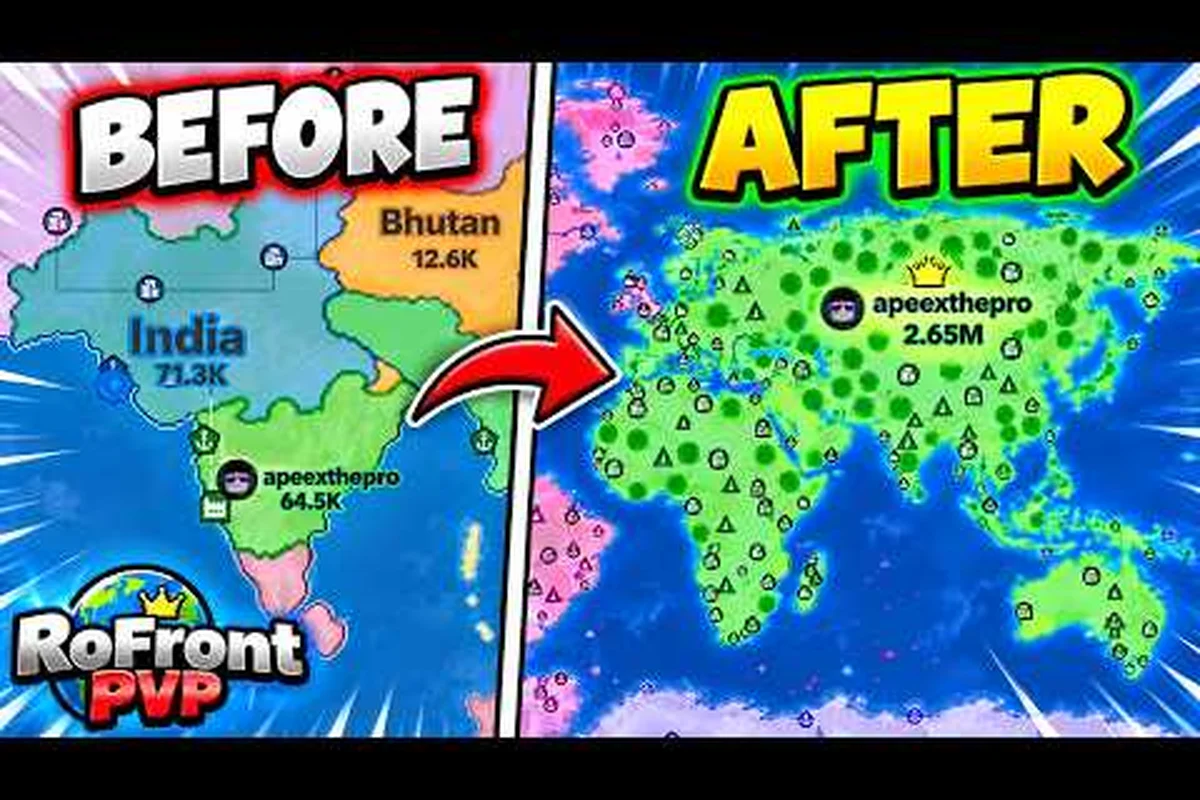
Territorial control decides the RoFront match, so a smart rofront territorial control guide matters from the first move. Learn where to expand, when to fight, and how to turn captured land into enough power to claim 80% of the world.
RoFront Territorial Control Fundamentals
The official RoFront game page identifies territorial control as the central objective: a match is won by controlling 80% of the world. That makes expansion more than a side activity. A strong economy without enough land may lose ground to a faster neighbor, while a large territory without infrastructure can become expensive to defend.
A useful rofront territorial control guide therefore treats conquest as a linked system rather than a series of isolated captures. You need money to maintain armies, armies to take land, captured land to generate resources, and those resources to support further attacks. The strongest players keep that loop moving without spreading their forces so thin that enemies can reverse their gains.
The four-part expansion loop
| Expansion stage | Main objective | Common mistake | Better decision |
|---|---|---|---|
| Economic setup | Build a dependable income source | Spending every available resource immediately | Reserve enough to produce and maintain troops |
| First claim | Secure nearby unclaimed land | Racing across the map with no support | Capture close, reachable territory first |
| Consolidation | Connect gains and stabilize borders | Leaving isolated pockets exposed | Prioritize connected land near friendly territory |
| Major push | Break a strong enemy’s control | Attacking the largest nation first | Target weak borders and divided opponents |
Economic readiness is the first real expansion requirement. Money spent on troops cannot also pay for factories, ports, and other infrastructure. This rofront expansion strategy treats income as the fuel behind every attack, because a larger army without a production base is difficult to replace after a failed push.
Contiguity is the second requirement. A compact block of territory is usually easier to defend and administer than several distant claims. A cluster of cities, factories, and ports can support nearby fronts, while an isolated settlement may force troops to move farther than the player can afford.
Opportunity cost is the third. Every claim creates another border that may require attention. Before expanding, ask whether the new land produces more than it costs in defense and administration. A player with 20% of the world can be stronger than one with 35% if the larger player has overextended borders and cannot protect its economy.
Timing is the fourth. The best opening window may appear before opponents establish strong defenses, but rushing can leave a player bankrupt. This guide treats early expansion as a balance between income, army readiness, and neighboring threat rather than a race to the farthest visible tile.
RoFront Unclaimed Land Priorities
Unclaimed land offers room to grow without immediately damaging another player, yet not every empty region has equal value. A useful rofront unclaimed land guide evaluates distance, resources, terrain, connection points, and the possibility of becoming trapped between stronger nations.
The best early territory is usually not the most distant land. It is the closest usable area that can connect to your existing position, generate useful production, and preserve several retreat or attack routes. If expansion begins across the map, troops spend more time marching than fighting, and the journey becomes vulnerable to interception.
Land-value comparison
| Land characteristic | Expansion value | Reason | Practical response |
|---|---|---|---|
| Adjacent to your territory | High | Shorter supply route and easier reinforcement | Claim it before pushing farther away |
| Connected by road or river | High | Faster movement and stronger logistical links | Preserve the corridor while expanding |
| Near useful resource sites | High | Supports factories, ports, and military production | Build only what the area can support |
| Behind a major enemy | Low initially | Retreat and reinforcement are difficult | Delay until the front opens |
| Valuable but isolated | Conditional | Useful later, expensive to hold now | Mark it as a mid-game objective |
Distance cost is more important than raw mileage. A distant tile may be close in straight-line distance but separated by hostile territory, difficult terrain, or a narrow route that one army can block. Analyze the actual path your troops would use, because a safe one-turn approach is usually better than a short but exposed one.
Resource adjacency determines whether captured land strengthens your position. Land near valuable nodes can support continued growth, whereas empty space may enlarge your percentage without improving income. Use the RoFront map-reading guide to evaluate routes, borders, and connected territory before committing.
Strategic depth also matters. A small inland area may offer little, while a coastal or resource-rich region can become a valuable transfer point between zones. Players who understand the map can identify these locations before a crowded front closes around them.
A practical rofront how to take unclaimed lands approach is to claim in layers. First capture one nearby district, then secure the neighboring corridor, and only afterward reach for the larger prize. This method creates a continuous base from which to defend, trade, and launch attacks. It also makes your territorial percentage easier to defend because the enemy cannot attack one vulnerable outpost and ignore the rest.
RoFront Expansion Strategy by Game Phase
Expansion should accelerate as income and military capacity improve, but the operating method changes. Early expansion prioritizes nearby land and basic infrastructure. The middle game targets connected enemy territory. The late game focuses on breaking major blocs and protecting the land needed to reach 80%.
This rofront expansion guide divides the match into practical phases without pretending that every server follows identical timings. RoFront had no public changelog and limited official balance data when the game page snapshot was verified on October 25, 2026, so troop costs, income rates, and building timings may change with updates.
Early game: establish a strong local core
Begin with a compact area around your starting position. Gather resources, construct the infrastructure needed for steady income, and use a modest force to take nearby unclaimed land. The objective is not maximum size; it is creating a defensible economic core before enemies know your production capacity.
| Early-game priority | Why it matters | Completion signal |
|---|---|---|
| Establish basic income | Funds troops and construction | Production remains stable after short battles |
| Capture adjacent land | Improves room to maneuver | Most settlements are within a short reinforcement route |
| Maintain a combat reserve | Prevents losses from forcing another dead end | You can defend while continuing to expand |
| Protect key infrastructure | Stops counterattacks from undoing progress | Enemy attacks fail to create a lasting breach |
Reserve discipline is the most useful early principle. For example, if an attack on unclaimed land requires most of your available troops, keep a second small force available to repair damaged settlements or recapture a lost route; committing every unit may deliver land quickly, but a failed battle leaves no money to rebuild. A maintained combat reserve lets you defend the economic core while still taking adjacent land, and it prevents one counterattack from undoing the progress shown by the Protect key infrastructure priority.
Players in community discussions report that early income and troop production strongly affect the first hour of play. Those reports are useful as strategic experience rather than fixed formulas, especially because the map and balance can change. For a deeper look at building a reliable money engine, use the RoFront economy guide.
Middle game: convert space into pressure
Once nearby land is secure, attack outward against a neighbor whose weakness is clearer than your own. Look for divided borders, exposed infrastructure, or an opponent focused on distant expansion. Your goal is to capture enough connected territory to improve the economy while forcing the enemy to spend on defense.
Front pressure is different from a single raid. A raid can destroy buildings, but sustained control of territory produces a durable advantage. Use short advances to identify resistance, then concentrate successful pushes on a single corridor. Attempting several simultaneous attacks usually splits production and can leave every front underfunded.
Late game: dismantle the largest blockers
At 60% or 70% control, random expansion becomes inefficient. A single nearby opponent may hold the remaining percentage needed for victory, so focus on breaking that player’s territorial continuity. Capture a few high-value districts, connect them, and make the conquered region part of your economy.
Do not ignore a second major nation. If two players can prevent you from reaching 80%, alternating pressure may be necessary. However, alternating attacks should follow successful recoveries, not forced constant switching. A short reinforcement pause can preserve troops for the next decisive push.
Military reserve depth becomes more important than another isolated tile in the late game. A captured district should link to your main territorial network and reinforce the attack route toward the victory threshold, rather than leave a disconnected defensive obligation. For example, taking three districts around a major opponent is less valuable if they sit behind an unbroken frontline; capture a connecting district first, then use the resulting supply route to stage reinforcements for the next push. This makes each expansion action contribute to territorial control and the broader win condition.
RoFront How to Expand Fast Without Overextending
Fast expansion is not simply attacking more often. It is reducing the time between income, recruitment, movement, and capture. The best rofront how to expand fast methods shorten that cycle while preserving a margin for failure. A player who always commits every troop may expand quickly for one battle and stall for the next several.
Compare expansion methods
| Expansion method | Speed | Risk | Best use |
|---|---|---|---|
| Adjacent unclaimed captures | Fast and steady | Low | Opening and early consolidation |
| Concentrated border attack | Fast if successful | Medium | Capturing connected enemy land |
| Distant surprise attack | Potentially fast | High | Recovering a threatened position or exploiting an exposed flank |
| Simultaneous multi-front push | Fast on paper | High | Armies with strong reserves and reliable production |
| Building-first preparation | Slower initial growth | Low | Stabilizing a dangerous economy or preparing a major push |
Batch production is one practical accelerator. When resources and capacity allow, prepare the next army while the current force is moving or fighting, which reduces the idle gap between operations. The exact production system may change, so treat this as a timing principle rather than a precise formula.
Route discipline is another. Moving along known friendly corridors is usually faster in strategic terms than taking a risky shortcut through hostile land. A march that arrives with intact troops is more valuable than one that reaches its destination depleted. Learn the map’s gateways and preserve access to them.
Parallel construction should only follow a firm foundation. If factories, ports, or settlements can operate without constant interruptions, building them during military downtime is efficient. If they compete with troop production for the same funds, choose the bottleneck. Your RoFront domination strategy can help compare economic and military priorities.
A balanced expansion cycle should combine one low-risk opening capture with a concentrated follow-up, rather than relying on a distant surprise attack. For example, secure nearby unclaimed land to improve resource coverage, then build a combat force before probing a vulnerable neighboring border. If the border operation stalls, the economy and production structure remain intact; if it succeeds, the captured territory can be consolidated before committing to a larger multi-front push. This creates a measured risk curve: the table’s “Fast and steady” adjacent captures provide the foundation, while the higher-risk methods are reserved for a clearly favorable opportunity.
-
Secure enough unclaimed land to support production.
-
Build a small combat force without stopping all economic development.
-
Identify a vulnerable neighboring border.
-
Concentrate force, capture connected territory, and consolidate it.
-
Use the enlarged economy to prepare the next operation.
Success is measured by retained land, not momentary map coverage. If your percentage rises but your economy falls, your position may be weaker. In the table, a “Fast and steady” adjacent capture is valuable only when the new territory continues generating resources without exposing production to border pressure. For example, after securing a connected unclaimed strip, compare the gain in resource coverage with the army and movement time required to defend it. Check income, border pressure, and movement time before celebrating a fast capture.
Defensive Planning for Controlled Territory
Territorial control requires more than offense. Each new district creates a border, and defending several disconnected borders can consume more troops than you can produce. A practical territorial plan identifies which places are worth holding, which can serve as buffers, and which should be abandoned when retreat is unavoidable.
RoFront includes alliances and large-scale weapons, but their exact availability and power depend on the current version. The official page mentions alliances and nukes among the broader match systems, yet it does not publish a reliable public changelog or exact troop and damage values. Avoid treating community estimates as permanent rules.
Border-risk matrix
| Border condition | Risk level | Best response |
|---|---|---|
| Single weak neighbor with a narrow approach | Low | Expand steadily and reinforce the contact point |
| Several opponents sharing the same border | Medium | Defend with reserves and avoid dividing troops |
| Enemy with strong production and recent gains | High | Fortify, negotiate if useful, and seek another front |
| Exposed district with poor retreat routes | Very high | Reinforce, use it as a forward post, or withdraw before encirclement |
Buffer territory can absorb a first strike and delay an enemy advance, giving nearby cities time to reinforce a vulnerable district. A distant outpost may add little economic output, but it can reveal the enemy’s attack timing before they reach your core. Choose the buffer by defensible access rather than raw distance: a narrow chokepoint with a viable retreat route is more useful than an isolated tile, especially when the border-risk matrix identifies several opponents sharing the same frontier.
Retreat planning prevents one defeat from becoming a total collapse. Maintain at least one route back to friendly infrastructure, because a retreating army that can regroup is still part of your strategy. A forward position without a viable exit forces a binary choice between holding and losing it.
Priority defense should protect the districts that support production or connect your holdings. Falling back from a remote claim may be sensible if doing so preserves the economy needed to retake it later. The RoFront endgame guide covers the broader progression of turning a strong position into a win, including the mistakes that can undermine a late push.
Avoid spending every military unit on the active front. A small home reserve gives you options when an enemy attacks a second border, a building is destroyed, or your main push stalls. You can also coordinate with allies, although every agreement should clarify borders, targets, and timing. Treat an alliance as a strategic arrangement, not a substitute for your own defensive capacity.
Correcting Common Expansion Mistakes
Even a strong economy can lose if expansion follows a repeating pattern of errors. The most common mistakes are taking distant land too early, fighting on multiple fronts with insufficient forces, and assuming every capture is worth holding. Correcting these habits is the fastest way to improve without changing every decision at once.
| Expansion mistake | Why it hurts | Correction |
|---|---|---|
| Chasing distant unclaimed land | Long supply lines and exposed marches | Take nearby districts first |
| Treating every empty tile equally | Some areas add no useful production | Evaluate resources and connections |
| Attacking the strongest player first | Higher resistance and heavier losses | Pressure a divided or weaker border |
| Dividing troops across every front | No force can achieve a breakthrough | Choose one main front |
| Spending all income on troops | Construction and replacements suffer | Keep a production reserve |
| Keeping isolated land out of pride | Each pocket creates a defensive burden | Consolidate into connected territory |
Shortcut thinking often creates the most surprising losses. A distant capture can look easy on the map, but the army may be unable to reinforce it afterward. Before launching an operation, trace both the attack route and the return route. If the return route crosses the same hostile ground without an alternative, increase your risk assessment.
Percentage chasing is another common error. Increasing land from 20% to 25% matters only if the new territory strengthens your position. It should either produce resources, protect a critical route, or place an enemy behind you. Territory that does none of these may be an expensive decoration.
Predictable attacks can be exploited. If your army repeatedly gathers at the same border, an opponent may defend it, launch a counterattack elsewhere, or offer an alliance to others. Vary your approach only when you have real options, though; random movement rarely beats a coordinated plan.
Finally, review every loss by asking whether it came from bad information, insufficient preparation, or execution. If a push failed because your army was too small, build more troops. If it failed because the target had a strong border, choose a different approach. If it failed because your income disappeared, repair production before attacking again. This rofront territorial control guide is strongest when treated as a repeatable decision process, not a list of one-time tricks.
Putting the Expansion Plan Into Practice
Consolidate your expansion plan into a short loop you can update after every battle. Start with a territorial target, list the production requirements, choose one approach route, and define the point at which you will reinforce or retreat. After the operation, record what changed in your economy and on the map. This makes your decisions more consistent without requiring you to micromanage every unit.
Quick decision checklist
-
Is the income stable? If not, repair production before launching another major attack.
-
Is the target connected to friendly territory? If not, assess the cost of reinforcing and securing it.
-
Does the target add strategic value? Confirm that it supplies resources, opens a route, or pressures an opponent.
-
Is the force sufficient for a breakthrough? Compare your available army with enemy resistance and keep reserves intact.
-
Is there a retreat route? If the only path runs through enemy land, reconsider the operation.
-
Can the new land be consolidated quickly? If not, make capturing a city or infrastructure center the first objective.
First-hour objective: establish steady income, claim adjacent land, and enter the midgame with a stable economy rather than the largest possible territory. For example, secure a resource-producing city and a nearby unclaimed plot before pushing toward a distant border; this keeps production and troop supply flowing while your frontline expands, and avoids a wide but fragile territorial line that opponents can exploit.
Midgame objective: capture one connected enemy region and link it directly to your existing holdings, creating a continuous territorial network rather than an isolated claim. Prioritize a resource-producing city or infrastructure center that closes a vulnerable border, then reinforce the junction between old and new territory with troop production and adequate defense. For example, taking an enemy settlement beside your frontline can increase income and prevent opponents from staging a counterattack, but leaving that connection thinly defended may turn the captured region into an entry point. Each gain should strengthen the next expansion instead of widening the frontline faster than the army can secure it.
Late-game objective: break the bloc controlling the remaining path toward 80%, while preserving enough production and defense to hold what you gain. Focus on the junction where that bloc meets your territory, since securing it can expose resource sites and prevent a counterattack from splitting your network. For example, if one enemy-held corridor leads to a resource-producing city, capture the connecting settlement first, reinforce the border, then push inward; the objective is not merely another flag, but a defensible route that keeps income, troop production, and reserve capacity functioning as the frontline advances.
Community-reported priority: income, troop production, and sensible border choices generally prove more valuable than rushed long-distance claims, although exact outcomes vary by server and current balance. In practical terms, a resource-producing city that raises your economy is usually a stronger first expansion than distant unclaimed land, while a border settlement can prevent an opponent from approaching your production network. Choosing the closer target preserves troop production and reduces the number of junctions that need reinforcement.
The path to 80% control is therefore a sequence of connected gains. Build income, secure nearby land, concentrate force against vulnerable borders, and incorporate every success into a larger defensible network. In RoFront, the player who controls the most ground is not always strongest; the decisive player is the one whose territory supports growth, reinforces itself, and denies opponents the space to recover.
Frequently Asked Questions
What is the fastest way to gain territory in RoFront?
The fastest dependable approach is to build income, capture adjacent unclaimed land, and then push one connected enemy border with a concentrated army. Distant attacks may appear quicker, but they take more time to supply and offer fewer reinforcement options. Exact income and troop timings can change, so measure progress by retained territory rather than a fixed early-game timer.
Should players take every unclaimed district they can reach?
No. A new district is worth taking when it produces resources, improves a supply route, connects your holdings, or pressures an opponent. Remote or isolated land can slow your economy and create extra borders. A useful rofront expansion strategy values the contribution of each capture to the wider position instead of maximizing map coverage at any cost.
How much territory is needed to win RoFront?
The official RoFront game page states that controlling 80% of the world is the victory condition. You do not need every district to contribute equally, because the 80% total is what matters, but your network should remain connected whenever possible. Plan how you will close the final gap before reaching the endgame so a large neighboring bloc cannot block your progress.
Is it better to attack an enemy or expand into unclaimed land?
Early in a match, nearby unclaimed land is usually safer because it improves your position without starting a costly war. Once your economy and army are stable, attacking a divided neighbor can create larger gains. If an enemy is much stronger, securing unclaimed space may be the better option, especially when it blocks that opponent from expanding toward you.
How can I stop enemies from reversing my expansion?
Protect the routes connecting your territories, keep a mobile combat reserve, and prioritize production districts that enemies can use to damage your economy. Retreat from an exposed pocket before it consumes troops needed for the main front. Alliances may help, but your own reinforcement speed and income determine whether captured land can be held when a major attack arrives.