
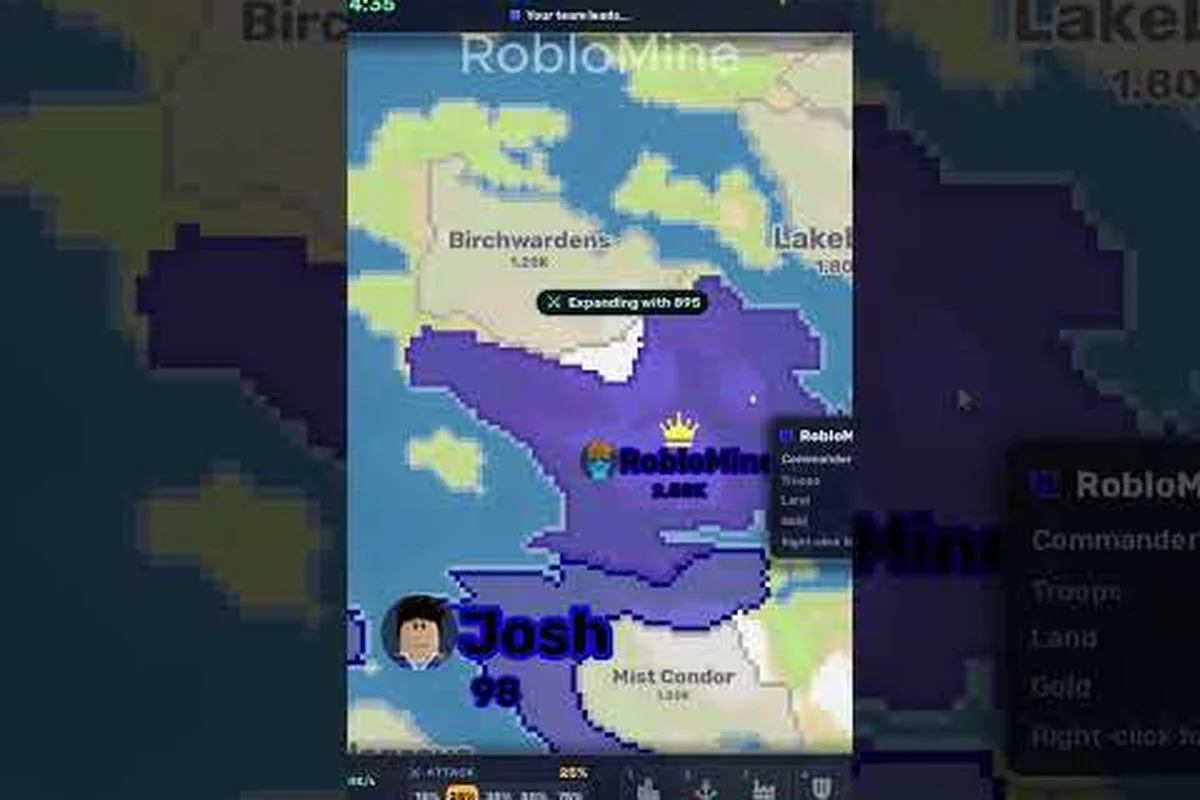
RoFront’s new features turn territorial expansion into a layered contest of economy, alliances, and nuclear power, making each front more than a simple capture zone. The 80% victory target rewards nations that combine resource control with flexible diplomacy: securing trade routes can fund war machines, while alliances can divide opponents before a nuclear exchange. Balance adjustments may shift the value of those systems, so scouting, production timing, and defensive positioning matter as much as firepower.
The official RoFront game page describes a shared world map with 88 player nations and hundreds of tribes. Because the server supports as many as 55 players, the update rewards coordination and rapid adaptation rather than a fixed build that always dominates.
RoFront New Features at a Glance
The most important RoFront new features are the connected systems behind territory control: cities, ports, factories, alliances, and nuclear weapons. Each addition creates a different kind of leverage, so the strongest approach depends on whether your nation controls coastline, industrial output, land, or diplomatic relationships.
| Feature | Core purpose | Strategic value | Main risk |
|---|---|---|---|
| 88 nations | Place several political powers on the map | More rivals and diplomatic options | Fragmented alliances |
| Hundreds of tribes | Add smaller groups beneath national control | Flexible manpower and local pressure | Conflicting loyalties |
| Cities | Anchor territory and support administration | Stable control and a base for expansion | Overextension |
| Ports | Support movement and coastal operations | Access to maritime routes | Exposure at sea |
| Factories | Strengthen production and military capacity | More resources for conquest | Resource pressure |
| Alliances | Coordinate between nations | Shared fronts and mutual defense | Broken commitments |
| Nukes | Create a high-impact strategic deterrent | Rapid pressure against fortified enemies | Wasted resources and backlash |
| 80% control target | Define the conquest victory condition | Rewards broad, coordinated expansion | A late-game leader race |
The conquest objective
The clearest change is the 80% territory-control objective. A player does not need every district on the map, but merely owning a few convenient strongholds is not enough to win. The threshold makes map position, coordinated expansion, and political reach more important than isolated combat victories.
This objective also makes the remaining 20% strategically dangerous. An enemy may control less land but occupy valuable choke points, coastal access, or industrial cities. Before committing troops to another broad front, check whether a capture will weaken an opponent’s economy or open a route toward a larger coalition.
The official feature set
According to the official page, RoFront was created on September 26, 2026 and updated on October 24, 2026, making this release cycle unusually short. The page snapshot also showed more than 43.6 million total visits, about 52,900 favorites, and roughly 20,800 concurrent players, which helps explain the rapid pace of iteration.
That speed matters when assessing RoFront gameplay changes. A strategy that looks strong today may reflect a temporary balance state rather than a permanent meta. Players seeking a concise record of individual revisions can use the RoFront update overview to distinguish feature launches from smaller adjustments.
Nations, Tribes, and Alliance Balance
The political structure is a major part of the RoFront newest features guide because control is not distributed evenly among 88 equal players. Nations sit above a wider population of tribes, and both levels can affect the map. This creates a layered contest in which local expansion may strengthen a national leader or strengthen a faction that later becomes a serious rival.
| Structure | What it represents | Advantage | Vulnerability |
|---|---|---|---|
| Nation | Large organized political power | Resources, coordination, and territorial reach | Greater scrutiny from rivals |
| Tribe | Smaller regional group | Local knowledge and focused force | Limited reach outside its area |
| Alliance | Cooperation among national powers | Combined fronts and stronger deterrence | Competing objectives |
| Neutral area | Unclaimed or weakly controlled land | Expansion opportunity | Costly travel and defense |
Why 88 nations change the battlefield
A crowded political map creates more possible enemies, but it also creates more possible partners. The practical difficulty is finding partners whose goals align with yours. One faction may share a border but value ports, while another controls factories and prefers a defensive settlement. A useful alliance therefore depends on common threats, shared access, and a clear division of responsibilities.
Community reports on the RoFront beginner strategies discussion emphasize that early economy, troop training, and deliberate expansion remain important. Because community data can lag the latest tuning, treat those observations as strategic context rather than a guaranteed balance sheet.
Alliance decision checklist
Before accepting a formal alliance, compare border pressure, production needs, and preferred targets. A factory-focused partner can cover troop and equipment output while a port-oriented partner controls coastal access, reducing internal competition over the same cities. For example, dividing these roles lets one faction protect factories and the other redirect forces toward a contested port, making joint attacks more practical when RoFront balance changes shift the relative value of production and defense.
-
Shared target: Identify an enemy or region that benefits both parties.
-
Clear access: Confirm which borders, cities, and ports the group can use.
-
Resource role: Decide who supplies troops, production, or intelligence.
-
Conflict limit: Set expectations for disputed territory before expanding.
-
Recovery plan: Determine how members support one another after a setback.
RoFront balance changes may alter the value of an alliance even when no formal alliance system changes. For example, if a city becomes easier to defend, players may spend less time securing it and more time contesting ports. If factories receive stronger production value, industrial nations gain leverage over smaller groups that depend on outside support.
Cities, Ports, and Factories
The territorial economy is the foundation of the RoFront new features because every large military push depends on infrastructure. Cities support consolidation, ports expand movement options, and factories improve the ability to produce military pressure. Treating these structures as interchangeable objectives creates inefficient campaigns.
| Structure | Best operational use | Common mistake |
|---|---|---|
| City | Secure a regional core and protect nearby land | Leaving it lightly defended |
| Port | Support coastal access and overseas movement | Expanding without a safe route home |
| Factory | Increase production for a sustained offensive | Capturing one and ignoring the economy around it |
Build a connected territory
A reliable opening begins with one city, one production route, and a protected connection between them. From that base, add another settlement only when the first remains stable. This sequence creates a network that can supply troops, while preventing the common mistake of claiming several disconnected regions that cannot be defended.
The territorial core principle is simple: a captured city should improve your position rather than create another isolated front. Look at the route between settlements, identify nearby enemy influence, and assign defenders before treating a new capture as finished. That habit remains effective when RoFront balance patch adjustments alter costs or production values.
Coastal and industrial priorities
Ports may be especially valuable when a nation needs to bypass a land bottleneck. However, controlling a port without protecting nearby territory can make it a target. Factories are equally vulnerable if enemies can disrupt the region around them, so a factory should be supported by a city and a clear approach route.
Use the RoFront strategy for beginners to compare broad economic roles before committing. A mixed strategy often works better than a one-note build because it reduces the impact of a single territorial loss. If a port falls, cities and factories may remain functional; if a factory falls, the same network can still defend an allied city.
Nuclear Weapons and Strategic Deterrence
Nukes are among the most eye-catching RoFront new features, but their value depends on the situation. A nuclear attack can punish a fortified enemy, break a siege, or signal that your nation will respond to major aggression. It can also consume resources without preventing the target from rebuilding, especially if the strike is used without a follow-up plan.
| Use case | Effectiveness | Reason |
|---|---|---|
| Punishing a fortified position | High | Pressure reduces the enemy’s defensive advantage |
| Supporting an allied advance | Medium to high | Creates urgency while allied forces move |
| Opening a stalled front | High | May force defenders to redeploy |
| Attacking an undefended village | Low | Wastes a limited strategic resource |
| Deterring a major rival | Medium | Works only if the threat is credible |
Make every launch support an objective
Treat a nuclear strike as part of a larger operation rather than an isolated event. Define the target, the desired response, and the force that will occupy the area afterward. A launch followed by no advance may damage infrastructure, but it does not automatically deliver lasting territory.
A good sequence is to weaken the target, move conventional forces into position, and launch when allied action creates the greatest distraction. The Radex Tips gameplay video also emphasizes money, effective nuclear use, and expansion, which reflects the close relationship between economic strength and high-impact attacks.
Deterrence and resource management
Nukes work partly as a threat. If rivals believe you can respond to an occupation attempt, they may redirect their troops elsewhere. However, deterrence fails when a launch appears routine or when the cost of using it is not justified. Save the weapon for a target where it changes the campaign, and monitor whether the balance update favors a particular timing window.
Players should also track how opponents respond. If repeated nuclear use causes stronger coalitions, retaliation, or defensive concentration, the weapon may have a political cost even when the physical strike succeeds. A measured policy can preserve credibility while conserving resources for the decisive phase near the 80% control objective.
Applying RoFront Gameplay Changes to Your Strategy
RoFront gameplay changes matter most when they alter the relationship between economy, territorial value, and force. Instead of asking whether one weapon or unit is strongest, evaluate what each faction can protect, produce, and threaten. That produces a strategy that remains understandable when numbers and priorities move.
| Strategic priority | Preferred target | Supporting action | Common trap |
|---|---|---|---|
| Stable expansion | Cities | Build a defended regional network | Chasing every capture |
| Economic growth | Factories | Secure supply routes and nearby land | Overinvesting in one structure |
| Fast access | Ports | Patrol routes and protect landing areas | Ignoring land defenders |
| Coalition pressure | Enemy alliance territory | Coordinate synchronized attacks | Fighting rivals separately |
| Late-game victory | Key choke points | Hold strong coalitions at bay | Attacking the leader too early |
Read the current patch signals
The RoFront balance update should be treated as a set of incentives. If factories become more valuable, production becomes a stronger early objective. If city defense improves, sieges may take longer while players contest routes. If nuclear effects rise, a concentrated enemy formation may become riskier than a scattered network.
Compare the current state with the RoFront update highlights to identify whether a change affects movement, production, combat, or victory progress. A balance patch may be numerically small, but it can alter the best sequence of actions. A one-percentage-point shift in capture speed, for example, can influence which border becomes the main battlefield.
Test one change at a time
Avoid changing an entire strategy after every update. Pick one measurable behavior, such as the time required to stabilize a new city, then test it over several matches. Record whether the change creates faster expansion, stronger defense, or more exposed borders. This method makes the RoFront balance update easier to evaluate and reduces the chance of reacting to random match outcomes.
A controlled test also clarifies whether a problem comes from the game or from your execution. If a new build loses ground quickly, compare its early economy, army size, and territory arrangement with the previous approach. The newest features guide should ultimately support better decisions, not simply list every available option.
A Practical Plan for the 80% Conquest Goal
Reaching 80% control requires a sequence, not one perfect opening. Secure the local economy, connect valuable settlements, form a useful coalition, and then expand toward regions that reduce an opponent’s ability to contest you. The following plan turns the feature set into a repeatable campaign.
Phase 1: Establish an economic base
Choose a starting region with defensible space and enough room to build. Protect the first city, establish production, and avoid overextending into isolated territory. A compact base is easier to defend than several scattered captures, which is especially important when nearby nations are watching for an opening.
Phase 2: Build a connected network
Add a port if coastal access supports your plan, or prioritize factories if your nation relies on production. Secure the routes between structures and designate defenders for exposed settlements. This stage creates the foundation for larger campaigns without forcing every advantage onto the front line.
Phase 3: Form a practical alliance
Find a neighbor whose strengths complement yours. One faction might hold the land while another provides production, or the partnership can divide pressure across two borders. Agree on the target and avoid making the alliance responsible for every possible dispute.
Phase 4: Apply concentrated force
Choose a border where combined troops, production, and terrain create the best chance of a breakthrough. Use conventional forces to pin defenders while reserving a nuclear strike for the moment it can create a meaningful opening. Occupation must follow the attack if the objective is lasting control.
Phase 5: Protect the victory path
At the 80% threshold, every percentage point can affect the leader race. Guard cities and factories, hold key routes, and stop expanding merely to increase the number. A controlled 75% region with strong defenses may be more valuable than a hurried 85% claim surrounded by unstable settlements.
Frequently Asked Questions
What are the main RoFront new features?
The main additions include 88 nations, hundreds of tribes, cities, ports, factories, alliances, nuclear weapons, and an 80% territory-control objective. This broadens the campaign beyond direct troop combat: ports and factories support production, alliances coordinate regional pressure, and nuclear weapons create a deterrence option. Because every settlement contributes to the control threshold, players must balance rapid expansion with securing connected territory for the conquest race.
How do the 80% control objective and nuclear weapons work?
The objective requires controlling 80% of the world to win, so every settlement can affect the final conquest race. Nuclear weapons can punish fortified positions or support a larger offensive, but they are most effective when conventional forces are ready to occupy the area afterward.
Did the RoFront balance update change the best strategy?
The balance update can shift the value of production, city defense, movement, and nuclear use even when the core rules remain intact. Players should assess which incentives changed rather than copying a fixed build, because the official game page shows a release cycle updated only days before the verification date.
Are alliances necessary in RoFront?
Alliances are not mandatory for small-scale play, but they become increasingly useful when several powers contest the same region. The 88-nation map creates opportunities for complementary roles, such as one partner providing land access while another supplies production or forces against a shared target.
Where can I find a clear overview of RoFront gameplay changes?
The RoFront latest update overview organizes individual changes, while this guide explains their strategic purpose. Comparing the official feature set with current balance reports helps players distinguish persistent mechanics from temporary adjustments.
RoFront new features create a conquest loop built around territory, production, alliances, and deterrence. The strongest approach keeps cities, ports, and factories connected, uses nuclear power selectively, and treats the 80% objective as a long-term campaign rather than an isolated score target.