
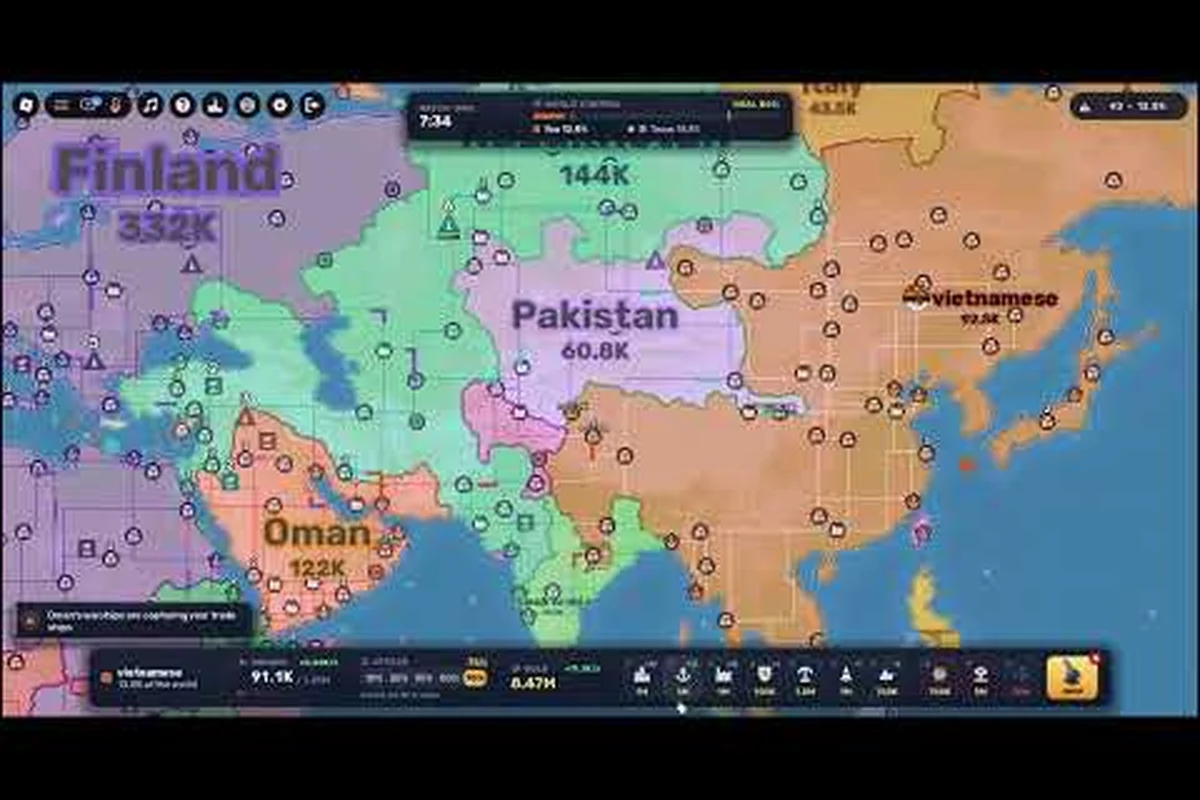
RoFront multiplayer guide strategies turn an 88-player shared map from a chaotic battlefield into a coordinated campaign. Mastery depends on choosing a strong start, managing mobile controls, and understanding the economy behind every conquest.
RoFront Multiplayer Strategy Overview
RoFront is built around real-time territorial competition, so a strong commander must balance expansion, defense, and economic development instead of sending every available unit forward. The official RoFront game page describes a shared world with 88 player nations, hundreds of tribes, cities, ports, factories, alliances, and nuclear weapons. Understanding that structure is essential because each opponent can threaten a different part of your territory.
The listed match format is ambitious: players must conquer 80% of the world to win, while the individual server page showed a 55-player cap in the verified October 2026 snapshot. Because server population and balance details can change, treat those figures as current reference points rather than permanent rules. A successful approach should remain flexible even when your lobby differs in size or composition.
| Strategic priority | What success looks like | Common mistake |
|---|---|---|
| Early economy | Cities, ports, and factories support steady production | Expanding before production stabilizes |
| Territorial control | Connected territory reduces travel and exposure | Attacking distant rivals too soon |
| Army management | Units arrive together and match the target | Sending every troop on one raid |
| Diplomacy | Allies cover weak borders | Relying on alliances without clear roles |
| Victory planning | Actions contribute toward the 80% objective | Chasing isolated land without a broader plan |
This 80% world-control objective creates an important lesson: individual kills rarely matter as much as land, production, and map control. Before joining a large lobby, review the RoFront beginner guide for the basic progression loop, then use this multiplayer guide to improve how you operate under pressure.
A Practical Match Plan
Begin by securing nearby territory and identifying which neighboring nation is expanding toward you. Next, stabilize production and establish a visible border before making a large offensive. Keep a reserve army for emergencies, defend ports and factories, and choose one clear partner when an alliance benefits your position.
The plan should remain flexible because every battle can pull attention toward a different border. Experienced players often use three simultaneous layers: a main strike force, a border defense force, and a production reserve. That structure allows a commander to respond without abandoning the entire front.
RoFront Game Mechanics Explained
The core multiplayer loop connects land, production, and military pressure. Cities support expansion, ports improve movement and supply access, factories strengthen production, and troops turn economic control into conquered territory. Nukes can alter a local balance, but they do not replace the need for a sustainable army or a defensible economy.
According to the official game page, a match can feature 88 player nations and hundreds of tribes, with the broader world designed around 80% conquest. These systems create a layered battlefield. Your own units may be effective, but neighboring players can still cut your supply lines, pressure your weakest settlement, or use alliances to turn one front into two.
| Mechanic | Multiplayer effect | Practical response |
|---|---|---|
| Territory control | Opens space for cities and production | Expand along connected fronts |
| City economy | Supports growth and military upkeep | Improve the economy near threatened borders |
| Port access | Helps movement and regional logistics | Protect ports before rival advances |
| Factories | Increase production capacity | Hold industrial centers as strategic priorities |
| Alliances | Divide attention across multiple fronts | Assign each ally a clear role |
| Nuclear weapons | Create a dramatic temporary shift | Use defensively and protect core territory |
Economy Before Aggression
A nation that captures land faster than it develops it becomes vulnerable. Every new settlement adds value only if it can operate safely, while exposed factories and ports can give an opponent a stronger reason to attack. A sensible approach is to measure production stability before committing troops to another large offensive.
Community reports from the r/Roonby beginner strategy thread emphasize developing the economy, training troops, and fighting neighboring nations as central parts of winning. Because community advice can lag behind balance changes, use those tactics as principles rather than assuming every current interaction behaves identically.
Why Land Multiplier Matters
Controlling scattered pockets may look impressive on the map, but each disconnected area demands attention. Connected territory makes defense easier, reduces wasted movement, and gives your economy more opportunities to work as one system. The best invasions therefore often remove a border, secure nearby production, and then advance deeper.
Avoid measuring success only by towns captured. A victory that leaves a nation with exposed cities, depleted reserves, and no supply route can be worse than a smaller operation. This is where mechanics explained becomes practical: each map action changes the value of your other territories.
RoFront Mobile Controls Guide
Mobile play does not require memorizing complicated button combinations. The important part is establishing a predictable routine for moving the camera, selecting units, issuing orders, and checking threats. In this rofront mobile controls guide, the focus is on reducing misclicks and keeping your attention on the map rather than the interface.
A useful setup keeps movement, combat, and information actions in separate mental zones. One thumb or control area handles camera movement, another handles selection and orders, and a dedicated glance returns to the map whenever a notification appears. Because device layouts and control settings may vary by platform or version, confirm the exact positions in-game before relying on screenshots from another player.
| Mobile action | Recommended approach | Why it helps |
|---|---|---|
| Camera movement | Move in short, controlled sweeps | Faster detection of border threats |
| Unit selection | Select groups instead of individual troops | Easier coordinated attacks |
| Order confirmation | Verify destination and target before confirming | Reduces accidental diversions |
| Base defense | Keep a dedicated defensive group ready | Reacts faster to multi-pronged attacks |
| Inventory check | Review production during safe pauses | Prevents idle factories or queues |
| Map awareness | Check rivals, allies, and your border regularly | Reveals coordinated enemy movement |
A Repeatable Control Routine
Begin each match by panning across your territory in one direction, then reverse the direction. This repeated sweep trains you to spot missing units, moving rival markers, and threats near your production. It also reduces the chance that a notification near one border distracts you from a more important attack elsewhere.
When an engagement begins, select a group, issue a movement order, and watch until the group reaches its destination. Chasing a target with repeated taps can pull units into an unfavorable position, especially when the target retreats toward reinforcements. Use a wider camera view to confirm that your army is moving as a group rather than spreading through uneven terrain.
Reducing Input Errors
Keep orders simple during the first few minutes of a fight. A clear stop position, a second rally point, and one fallback route are more useful than five simultaneous destinations. If your army begins taking losses, pull it back to a safe area before reorganizing, because a rapid retreat can become a rout if it is triggered without a plan.
Players who struggle with the first minutes can use the RoFront controls guide alongside this broader strategy. More important than memorizing a fixed button arrangement is practicing one consistent sequence: scan, select, order, verify.
RoFront How to Play on Mobile Successfully
Playing on mobile well requires reducing the number of decisions made under pressure. You do not need to supervise every unit continuously; instead, build a system that keeps your strongest force grouped, reserves enough resources for defense, and creates checkpoints at key territory. This approach supports the same broad strategy used on larger screens without demanding constant rapid tapping.
The official page reports more than 43.6 million total visits, 52,900 favorites, and roughly 20,800 concurrent players in the October 25, 2026 snapshot. Those figures suggest a busy multiplayer environment, although server populations vary by time. A crowded lobby can provide useful allies and targets, but it also means several large powers may compete over the same border.
| Mobile priority | Early game | Mid game | Late game |
|---|---|---|---|
| Economy | Develop starting cities | Expand ports and factories | Reinforce critical production |
| Army | Keep one main field group | Add a defensive reserve | Coordinate focused offensives |
| Map control | Claim nearby territory | Secure connected borders | Target high-value regions |
| Diplomacy | Observe active alliances | Confirm partner roles | Avoid overextending commitments |
| Attention | Short regular map sweeps | Check frontlines every few minutes | Review every active front before major orders |
Reduce the Load on Your Attention
Set a recurring rhythm for checking the map rather than reacting to every alert. A player who checks all four borders every few minutes may notice a developing threat early and still avoid the distraction of constant unit micro-management. The exact interval should match your alert frequency, since busy lobbies and large armies may require more frequent reviews.
Avoid spreading a single army across several targets. If a force cannot defeat one defender decisively, splitting it often gives the enemy two weak fronts to exploit. When you need a second attack, use another group or coordinate with an ally instead. The RoFront strategy guide expands on timing, and that timing becomes especially important when every decision occurs on a smaller screen.
Build a Defensive Buffer
A mobile player should keep one meaningful defensive option near the home territory. It need not remain permanently idle; it can support a nearby operation while staying close enough to return. The buffer protects factories, cities, and ports if a rival suddenly attacks.
Do not send every combat unit toward a distant objective on the assumption that allies will cover the rear. Shared wars create changing priorities, and an ally may be dealing with its own emergency. A reserve is valuable because it turns a potential collapse into a manageable setback.
RoFront Hidden Mechanics Guide
The most useful hidden mechanics are operational rather than secret buttons. They are the map pressure, routing, coordination, and economy rules that experienced players use without explicitly calling them out. This rofront hidden mechanics guide explains how those systems affect ordinary actions and how to turn them into practical habits.
A central hidden mechanic is attention transfer. When a player focuses on an offensive, the front opposite that offensive may become quieter without becoming safer. A single short enemy raid can exploit that shift, capture production, and reduce the attacking power of the distant army. Rotating your map checks prevents this because attention returns to neglected borders regularly.
| Underlying mechanic | Surface behavior | Skilled response |
|---|---|---|
| Attention transfer | One quiet front becomes dangerous | Alternate between offensive and defensive checks |
| Connected territory | Separate pockets require more defense | Expand in coherent corridors |
| Production depth | Captured land may outpace income | Develop new territory before overextending |
| Reinforcement timing | Arriving too late changes the result | Stage units before the decisive clash |
| Alliance opportunity cost | A partner has competing objectives | Agree on specific targets and borders |
| Scarcity signaling | Resource loss discourages commitment | Retreat before a losing fight drains reserves |
Rallies and Reinforcement Timing
Rally points matter because the same unit can arrive with a decisive advantage or become a reinforcement that arrives too late. Place a rally location where your force can gather without exposing it to an immediate counterattack. If the destination is far, the group may cross territory controlled by another player and lose time or condition before joining the battle.
Watch where opponents concentrate their forces as well as where they are fighting. A defender with several armies within range can rotate faster than a player who commits everything to one point. This makes apparent numerical strength deceptive; local reinforcement options can be more important than the total count visible on the map.
Diplomacy Has a Hidden Cost
Alliances reduce pressure, but they also create expectations. If your ally captures land for you, you may need to defend that ally elsewhere. If two partners expect you to attack the same target while one expects you to hold a different border, confusion can waste the entire alliance.
A useful agreement identifies three points: the border you will cover, the target you will help attack, and the condition that ends the commitment. Keep those points simple enough to remember during a battle. Clear roles are more valuable than dramatic promises because they influence actual orders.
RoFront Nation Selection and Early Expansion
Your first ten minutes shape every later option, so nation selection should match both the current match and your preferred play style. The RoFront nation selection guide provides deeper comparisons, while the multiplayer approach begins with geography, economy, and immediate neighbors rather than a national bonus alone.
Choose a start with enough economic potential to survive early pressure, but do not select a distant target before securing nearby ground. A strong home region gives you more time to establish production, but a weak border can still cause defeat. Inspect the map before committing and identify at least two safe expansion routes if possible.
| Early decision | Positive sign | Warning sign |
|---|---|---|
| Starting position | Multiple directions of safe growth | Enclosed by powerful rivals |
| Neighbor strength | One clear contestable border | Several coordinated attackers |
| Resource access | Production can expand near core territory | Dependence on remote islands |
| Army position | Units can defend and gather together | Troops split across distant zones |
| Alliance outlook | A partner complements your strength | Every partner wants the same target |
Claim a Functional Core
A functional core is the smallest area containing your main city, working production, defensible borders, and enough space for the army to operate. Capturing an isolated resource point may add value, but the core determines whether your nation can recover from a failed attack. Expand outward from a stable core rather than chasing attractive but disconnected targets.
During the first push, choose one of three routes: secure a safe economy, punish a weak nearby rival, or negotiate with a stable neighbor. Secure the economy if pressured, punish a weak rival when a quick victory would improve your position, and negotiate when the border is naturally defensible. Trying to do all three at once often leaves no clear priority.
Use Your First Victory Carefully
A successful early raid can create momentum, but chasing another victory with a damaged army can erase that advantage. Consolidate the captured territory, repair losses, and check whether the opponent has allies. A defeated player with powerful support may return, whereas a careful consolidation can turn one battle into permanent map control.
RoFront Multiplayer Combat and Alliance Tactics
Successful multiplayer combat depends on concentration, timing, and local information. A larger army should move toward a clear objective only after checking reinforcements, terrain, and nearby threats. The objective may be a city, a port, a factory, or a border position; each target offers different value and different risk.
The RoFront army guide explains how to organize units for stronger combat outcomes. In a multiplayer match, organization also prevents friendly groups from blocking one another and gives allies a clear point around which to coordinate.
| Combat approach | Best use | Main risk |
|---|---|---|
| Concentrated attack | Breaking one important defender | Long march exposes the force |
| Defensive stand | Protecting core production | Surrounding if the position is too deep |
| Two-front pressure | Splitting enemy attention | Friendly groups misread one another |
| Allied pincer | Compelling defenders away from one target | Delayed coordination |
| Limited raid | Gaining land or disrupting production | Inadequate force may create a costly stalemate |
Read the Battle Before Committing
Count visible units, then check for movements behind buildings, hills, or distant territory. A defender that appears small may have a nearby reinforcement group, and a quiet sector may hide a large force preparing to rotate. Avoid assuming that an opponent has committed every available army to the current fight.
Commit to a target only after deciding what success looks like. If the objective is a city, destroying defenders may not be enough if the opponent can rebuild. If the objective is to delay, holding a choke point can be more valuable than pursuing kills. Each battlefield should have a practical end condition, such as capturing a settlement, pushing a rival from a border, or preserving your army for the next engagement.
Coordinate Alliances Without Micromanaging
Share the border you need covered, the target you can reach, and the time at which you expect to act. A three-sentence message is often enough: “I will attack the eastern city after this production cycle; cover the northern port; disengage if the south is breached.” Specific arrangements reduce accidental conflicts between allied forces.
Do not expect an ally to guess your intentions. If your army must cross their defensive line, give notice and define a rally area. When both sides can attack the same settlement, appoint one side to lead the initial push and the other to cover escape routes or rear threats.
Advanced RoFront Multiplayer Guide Tactics
As the match develops, the objective shifts from gaining a few settlements to controlling the routes and resources needed to reach 80% conquest. At that stage, small optimization gains matter less than preventing a coalition from forming around you. You need enough defensible territory to support your army, enough production to replace losses, and enough allies to discourage attacks from several directions.
The advanced phase is also where map information becomes more valuable. A player who consistently sees the same routes can anticipate reinforcement paths and identify which border an opponent wants to open. A rofront game mechanics explained approach should therefore include scheduled intelligence checks, not merely reactive troop management.
| Late-game condition | Immediate concern | Practical adjustment |
|---|---|---|
| Enemy coalition forming | Multiple borders under pressure | Secure allies before a pincer begins |
| Production underperforming | Army cannot replace losses | Prioritize factories and protected cities |
| Large exposed offensive | Home territory becomes vulnerable | Maintain a home guard and timed return |
| Weak ally | Border may collapse unexpectedly | Cover the critical gap personally |
| High-value target exposed | Enemy may redirect all forces | Use deception and alternate axes |
Threat Routes and Opponent Intent
Watch not only where enemy armies are, but where they are heading. Repeated movement toward one border may be preparation for a major attack, especially if factories are producing and allies are active. A small raid can be a test of your reaction time, while a broad deployment usually signals a larger objective.
Maintain two plausible plans. One plan should describe your next offensive; the other should cover how you respond if the enemy attacks first. This prevents every decision from depending on a single forecast. If the first plan loses its advantage, you can shift to the defensive plan without abandoning every border at once.
Use Nukes as Tactical Pressure
The official game page confirms that nuclear weapons are part of the broader multiplayer format. Their impact depends on positioning, timing, and the surrounding battlefield. A launch can destroy an enemy concentration, but it may also create a new political reason for other nations to cooperate against you.
Save a decisive option for a meaningful target rather than using it to solve a routine defense. Before choosing a launch point, consider whether your conventional army can secure the area afterward. A weapon that eliminates defenders but leaves the settlement vulnerable may produce less lasting value than a coordinated ground attack.
Build a Final Victory Plan
When territory approaches the 80% threshold, map the remaining objectives and their defenders. Separate high-value regions from exposed targets, then assign your army groups according to travel distance and enemy threat. Keep one force mobile enough to reinforce a successful sector rather than committing every group to separate objectives.
The final phase rewards clarity. A player with 70% control but an uncoordinated plan can lose faster than one with slightly less territory and strong positioning. Confirm supply, production, and rally points before each major operation, because the last percentage can require several simultaneous pressures.
Frequently Asked Questions
What is the easiest way to win a RoFront multiplayer match?
Start by securing a connected economic core, developing cities, ports, and factories, and keeping a defensive army near your most valuable territory. Expand in one direction at a time, choose allies whose interests complement yours, and use coordinated attacks against exposed targets. Avoid scattering troops across distant fronts because a single coordinated enemy can exploit the gap.
Can RoFront be played comfortably on a mobile phone?
Yes, because the core systems can be managed through group selection, clear orders, and regular map checks. Keep the camera moving in short sweeps, verify destinations before confirming attacks, and protect factories, ports, and cities while focused on a distant objective. The exact control layout may vary, so confirm the current interface before a ranked or competitive session.
What should I prioritize early in a RoFront multiplayer game?
Prioritize economic stability and nearby security before launching a major conquest. Develop the territory that supports your army, identify the most dangerous neighboring nation, and avoid stretching across the map too soon. A limited early attack can be useful if it removes a threatening border, but capturing land without improving production may leave your nation exposed.
Are alliances necessary to win RoFront multiplayer matches?
Alliances are helpful but not automatically required, because their value depends on coordination and available targets. A reliable partner can cover a border, join a pinned attack, or reduce the number of enemies you must watch. Confirm each partner’s role, communicate before crossing friendly lines, and maintain your own defense because alliances can change as the match develops.
Which RoFront mechanics are most important on mobile?
The most important mechanics are territory continuity, production management, reinforcement timing, and attention to multiple fronts. Mobile play becomes difficult when units are split, orders are issued without verification, or one border is ignored during a distant fight. Use grouped selections, scheduled map sweeps, and a defensive reserve to keep those mechanics under control.